Protobuf wire format step-by-step
 Lab notebook: wire format playground · full MiniUser lab: lab_mini_protobuf_encoder.ipynb
Why this article exists
Imagine you open a network capture. You see a short sequence of bytes such as 08 01 12 03 41 64 61. Someone tells you “that is Protocol Buffers.” The slogan “binary with field numbers” does not by itself teach you how to read or write those bytes. It does not teach you how to debug a hexadecimal dump. It does not teach you how to implement even a small subset codec.
Without the wire rules, language tutorials stay at the API surface. Serialization 201 taught that Protocol Buffers is schema-dependent. That means the reader needs a schema, not just the bytes. Until you learn the wire rules, that idea never becomes something you can operate on yourself.
In this article you will learn the binary layout that Protocol Buffers uses on the wire. After reading it, you should be able to encode and decode a small teaching message by hand. You should also understand why unknown fields can be skipped safely.
This article assumes the 201 ideas in self-describing vs schema and schema evolution.
Official encoding reference: Protocol Buffers encoding.
Short answer
Protocol Buffers (proto3 binary encoding) store a message as a list of fields, one after another. Each field starts with a small integer called a tag (also called a key). The tag combines two pieces of information: which field this is (the field number) and how the following bytes are shaped (the wire type). After the tag comes a payload. The shape of the payload depends on the wire type. The payload may be a varint (a variable-length integer), a fixed 32-bit or 64-bit value, or a length-delimited blob (often abbreviated LEN). Length-delimited fields are used for strings, raw bytes, nested messages, and packed repeated numbers.
Field names never appear on the wire. A reader needs the schema—or equivalent knowledge of field numbers and types—to turn those numbers back into meaningful fields. Unknown field numbers are usually skipped. The decoder looks at the wire type and consumes the right number of bytes. That skip rule is why additive schema evolution works, as long as field numbers are never reused for a different meaning.
Prerequisites
- Comfort with hexadecimal notation and unsigned integers.
- 201 vocabulary: schema-dependent wire formats and additive field numbers.
- Optional: skim the suite schema
schemas/v2/protobuf/benchmark_v2.protofor realistic field numbers. This page uses a teaching mini-message, not a full suite fixture.
Mental model
A message is a sequence of fields. Each field looks like this on the wire:
[key varint] [payload...]The key is computed as:
key = (field_number << 3) | wire_typeIn plain language: shift the field number three bits left, then put the wire-type code in the low three bits. That integer is itself written as a varint. Varints are explained below.
| Wire type | Value | Payload |
|---|---|---|
| VARINT | 0 | unsigned varint (variable-length integer) |
| I64 | 1 | exactly 8 bytes, little-endian |
| LEN | 2 | a length (as a varint) n, then exactly n bytes |
| I32 | 5 | exactly 4 bytes, little-endian |
Endianness means the order of bytes in multi-byte fixed values. Protocol Buffers fixed types use little-endian order. The least significant byte comes first.
Example tag strip for id = 1 (field 1, varint payload):
08 01
^^ ^^
|  value = 1
key = (1<<3) | 0
Nested message example (field 3 is a manager whose only content is id = 2):
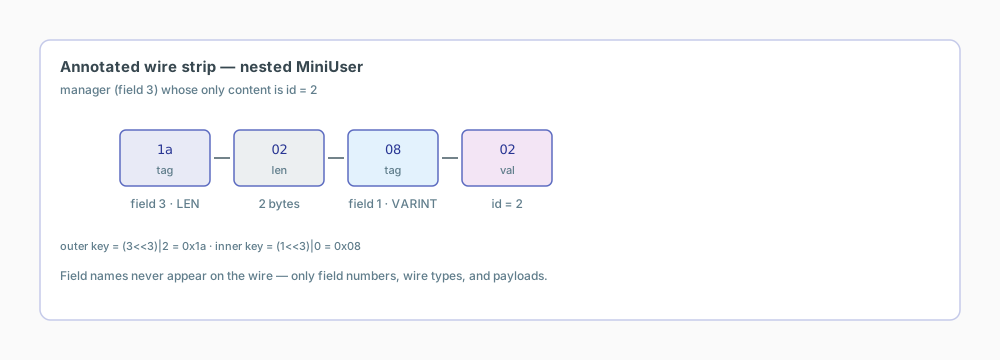
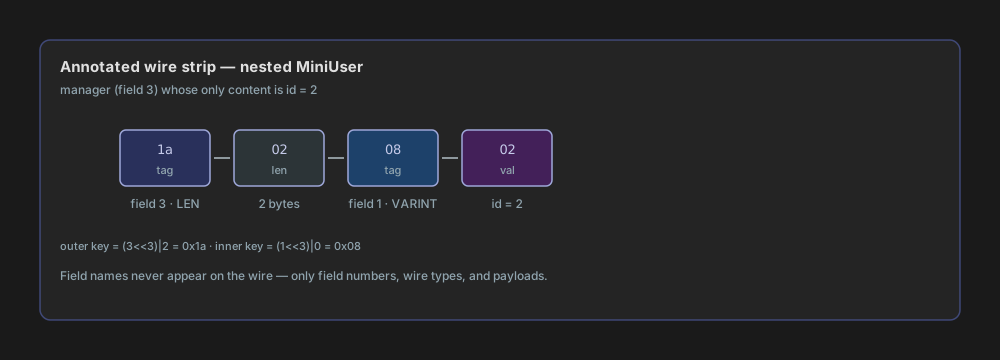
1a       02       08       02
^^       ^^       ^^       ^^
|        |        |        value = 2 (varint)
|        |        inner key = (1<<3)|0 = 0x08 (field 1, VARINT)
|        length of inner message = 2 bytes
outer key = (3<<3)|2 = 0x1a (field 3, LEN)
Wire types 3 and 4 are legacy “group” markers. Avoid them in new designs.
Teaching mini-message. The following schema is not a full suite fixture. It is also not schemas/v2/protobuf/benchmark_v2.proto. We use it so hex dumps stay small enough to reason about by hand:
syntax = "proto3";
message MiniUser {
  uint32 id = 1;           // varint
  string name = 2;         // length-delimited UTF-8
  MiniUser manager = 3;    // length-delimited nested message (optional)
  repeated uint32 tags = 4; // repeated varint (unpacked in the lab)
}
Step-by-step
1. Encode the key (tag)
In this section we encode the tag that names each field on the wire.
key = (field_number << 3) | wire_typeFor example, field 1 with wire type VARINT (0) gives key = (1 << 3) | 0 = 8 = 0x08.
Field 2 with wire type LEN (2) gives key = (2 << 3) | 2 = 18 = 0x12.
The key is itself a varint. For field numbers 1–15, a single-byte key is common. The low four bits of the field number fit beside the three-bit wire type. For field number 16 or higher, the key needs more than one byte:
| Field | Wire type | key value | Hex (key only) |
|---|---|---|---|
| 1 | VARINT (0) | 8 | 08 |
| 16 | VARINT (0) | 128 | 80 01 |
| 16 | LEN (2) | 130 | 82 01 |
This matters because large field numbers cost an extra byte on every occurrence of that field. Many schemas keep hot fields in the range 1–15 for that reason.
2. Encode a varint (unsigned base-128)
A varint (variable-length integer) stores an unsigned integer in base-128 groups. Each byte carries seven data bits. The high bit of a byte means “more bytes follow.” Small numbers use one byte. Large numbers use more. That is why Protocol Buffers is efficient for small integers. It does not fix every integer at four or eight bytes.
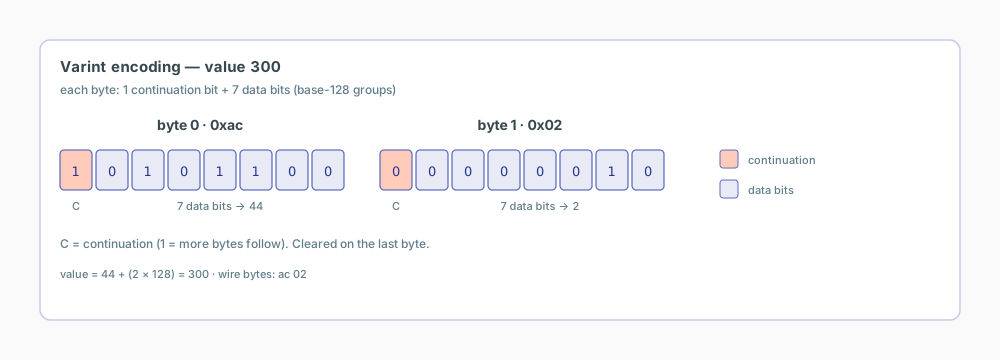
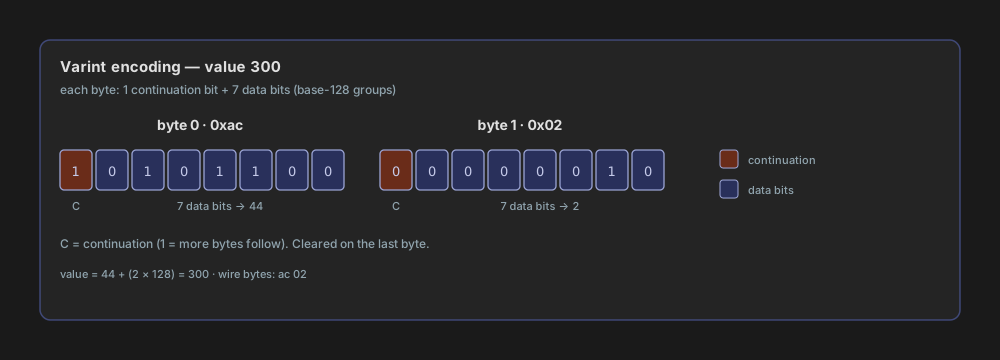
Algorithm:
- While the value is at least 128: emit
(value & 0x7f) | 0x80, then shift the value right by seven bits. - Finally emit the last seven-bit group with the high bit cleared.
| Decimal | Hex bytes (illustrative) |
|---|---|
| 1 | 01 |
| 127 | 7f |
| 128 | 80 01 |
| 300 | ac 02 |
Signed int32 / int64 in proto3 use ordinary varints of their two’s-complement bit pattern. Negative values therefore expand to many bytes. sint32 / sint64 use zigzag encoding so that small negatives become small varints. Zigzag is a mapping that interleaves non-negative and negative integers (0, −1, 1, −2, 2, …). Values near zero stay near zero on the wire. This course’s mini subset avoids sint unless you extend the lab yourself.
| Type | Logical −1 (illustrative) | Idea |
|---|---|---|
int32 / int64 |
many ff bytes as the unsigned varint of two’s complement |
Expensive when negatives are common |
sint32 / sint64 |
zigzag maps −1 to a small varint (for example 01) |
Prefer when negatives are common |
bool: false is often omitted in proto3 because it is the default. true is a tag plus the varint 01.
enum: encoded as the varint of the numeric enum value.
Varint failure modes (codec concerns)
A correct decoder must not assume that “integers are small.” It must also not assume that “the buffer is well-formed.” Every read must check that enough input remains:
| Failure | What goes wrong |
|---|---|
| Truncated mid-varint | The high bit is set on the last available byte, so more input is required but the stream ended |
| Overlong encoding | A value that fits in fewer bytes is written with extra continuation bytes; reject it or define a clear policy |
| Too many continuation bytes | Cap the length (for example ten bytes for a 64-bit value); otherwise a hostile stream of 0x80 bytes can become a denial-of-service |
| Truncated fixed or LEN | Not enough bytes remain for 4/8 fixed bytes, or for n payload bytes after a length prefix |
Hostile payloads as an operational problem are covered in 301 untrusted input. Bounds checks still belong inside the decoder itself.
3. Length-delimited fields (wire type 2, often called LEN)
In this section we look at fields whose payload size is not fixed in advance. Strings, byte arrays, nested messages, and packed repeated numbers all use wire type 2.
On the wire a length-delimited field is always:
[ key ][ len ][ payload bytes… ]When encoding, you usually stage the payload first so you know len before you write it:
- Build the payload bytes (UTF-8 for a string, raw bytes, or a nested message encoding) in a temporary buffer.
- Emit the key with wire type 2.
- Emit the length of that payload as a varint.
- Emit the payload bytes.
Do not emit the length after the payload on the wire. Staging the payload in memory first is fine. The on-wire order is always key, then length, then payload.
4. Nested message
A nested message is just another length-delimited blob. Its payload is itself a valid message encoding—the concatenation of that nested message’s fields. There is no special “nest” wire type. This matters because the same decode loop that handles strings also handles submessages. You read a length, then parse that slice as a message.
5. Repeated fields
A repeated field is a list of values of the same type. Protocol Buffers has two common ways to encode repeated numbers.
Unpacked (the lab default): for repeated uint32 tags = 4, emit one complete field (key plus varint value) per element. The same key may appear multiple times in one message.
Example for tags = [1, 2] only:
20 01 20 02
^^ ^^ ^^ ^^
|  |  |  value 2
|  |  key for field 4, VARINT, again
|  value 1
key (4<<3)|0 = 0x20
Packed (the proto3 default that many code generators use for primitive numeric repeated fields): a single length-delimited field whose payload is the concatenation of element encodings. There are no per-element tags inside the packed block.
Example for the same logical tags = [1, 2] as packed (field 4, LEN):
22       02       01 02
^^       ^^       ^^^^^
|        |        two varints: 1, 2
|        length of packed payload = 2
key (4<<3)|2 = 0x22
Decoders should accept both forms for the same field when the schema says repeated numeric. The lab implements unpacked only. Packed is a stretch goal.
6. Decode loop
When you decode, you walk the buffer from left to right until nothing remains. For each field you read a key. You split it into field number and wire type. Then you consume the payload that matches that wire type.
while bytes remain:
  key = read_varint()
  field_number = key >> 3
  wire_type    = key & 7
  switch wire_type:
    0: read_varint()
    1: read 8 bytes   # error if fewer remain
    2: n = read_varint(); read n bytes  # error if fewer remain
    5: read 4 bytes
    else: error or skip policy
  if field_number unknown: discard payload (skip)
  else: assign to schema field
Skipping unknown fields requires understanding the wire type so you consume the correct number of bytes. Do not assume every unknown field has a fixed size. Always check that the buffer has enough remaining bytes before you read.
7. Worked examples
G1 — MiniUser { id = 1, name = "Ada" } (no manager, no tags)
| Step | Meaning | Bytes (hex) |
|---|---|---|
| Field 1 | key (1<<3)\|0 = 8 |
08 |
| varint 1 | 01 |
|
| Field 2 | key (2<<3)\|2 = 18 |
12 |
| len = 3 | 03 |
|
UTF-8 Ada |
41 64 61 |
Full message: 08 01 12 03 41 64 61
G5 — nested manager = { id = 2 } only
| Step | Meaning | Bytes (hex) |
|---|---|---|
| Outer field 3 | key (3<<3)\|2 = 26 |
1a |
| length of inner message | 02 |
|
| Inner field 1 | key (1<<3)\|0 = 8 |
08 |
| varint 2 | 02 |
Full message: 1a 02 08 02
Verify these with any official parser that loads an equivalent .proto (see the lab).
In this suite
| Asset | Role |
|---|---|
schemas/v2/protobuf/benchmark_v2.proto |
Real multi-message suite schema—much larger than MiniUser |
| Python / Rust / C | Language runtime implementations of this wire format |
| 301 using this suite | How not to misuse Dashboard numbers when comparing libraries |
Wire layout is language-agnostic. Buffer ownership (who allocates and who frees) is covered in each language-path article.
Common mistakes
- Putting field names on the wire (classic Protocol Buffers binary does not do that).
- Reusing field numbers after deletion without marking them
reserved. - Forgetting the length prefix on strings.
- Emitting the length after the payload on the wire (confusing staging order with wire order).
- Treating message field order as semantically required (encoders may differ; decoders must accept any order).
- Decoding without a skip path for unknown tags.
- Reading a LEN length
nor a fixed width without checking remaining buffer length.
What this article is not
- A full proto3 language guide (maps, oneofs, extensions, editions, JSON mapping).
- gRPC framing (length-prefixed HTTP/2 messages wrap Protocol Buffers payloads; they are not the payload itself).
- Buffer ownership per language (see the language-path articles).
- A security playbook—see 301 untrusted input for hostile operational controls. The varint and LEN bounds above are the codec-side half of that story.
Key takeaways
- Protocol Buffers binary is a stream of tagged fields. The key is
(number << 3) | wire_type, written as a varint. Large field numbers need more than one key byte. - Payloads are varints, fixed 32/64-bit values, or length-delimited blobs (
key | len | payloadon the wire). - Nested messages are length-delimited messages. Unpacked repeated fields repeat tags. Packed repeated fields use one LEN of concatenated elements.
- Unknown fields are skipped by wire type. That rule is the foundation of additive evolution.
- Language-path articles show how code-generated runtimes apply these bytes. The lab builds a small subset by hand.