Zero-copy
Problem
In the classical serialization model, a byte sequence arrives and a parser constructs a new object graph in the language runtime. Application code then reads properties from those objects. Memory is later reclaimed, either manually or by garbage collection. Garbage collection (GC) is automatic reclamation of unused memory. That model is straightforward to reason about. It becomes expensive when messages are large, numerous, or only partly examined. The implementation pays to build full language objects in memory for fields that are never read.
Some formats are described as zero-copy, or are said not to deserialize. Such phrasing is easily misread as “costless and invariably safer.” The underlying mechanism is more precise. For a chosen endianness (byte order) and alignment policy, the on-the-wire layout is arranged so that fields can be read in place. Readers use offsets into the receive buffer. An offset is a distance in bytes from a known base. The design avoids allocating a parallel tree of language objects.
Short answer
In a zero-copy design, encoding produces a binary image whose fields are accessible through generated accessors or equivalent offset arithmetic applied directly to the receive buffer. There is no separate step that parses the entire message into ordinary language objects on the ordinary read path. That is what people mean by “does not deserialize” in the classical sense of building the full set of language objects in memory.
In this suite the row zero-copy layouts are FlatBuffers, Cap’n Proto, FlexBuffers, rkyv, cista, and Bebop. FlatBuffers and Cap’n Proto read fields through a separate schema. FlexBuffers is the FlatBuffers layout that stores type tags in the buffer. rkyv is a Rust archive, cista is a C++ layout of offsets, and Bebop is a schema-driven format whose reader can use a view of the buffer. Each stores one record. They are not columnar files such as Parquet. rkyv can be read in place, but this suite times it as a full materialize: decode builds an owned value, and that copy is included in the Dashboard time.
Encoding still requires work to construct that layout. Validation of untrusted buffers remains necessary. Omitting validation is a serious risk. Partial mutation is often awkward. Operational tooling differs from text-oriented formats. Zero-copy is a layout and a way of reading that layout. It still needs a schema or an equivalent contract, and it still needs a trust model.
This matters because marketing language can hide real costs. In-place reads can be very efficient. Construction, verification, and buffer lifetime still need careful design.
Mental model
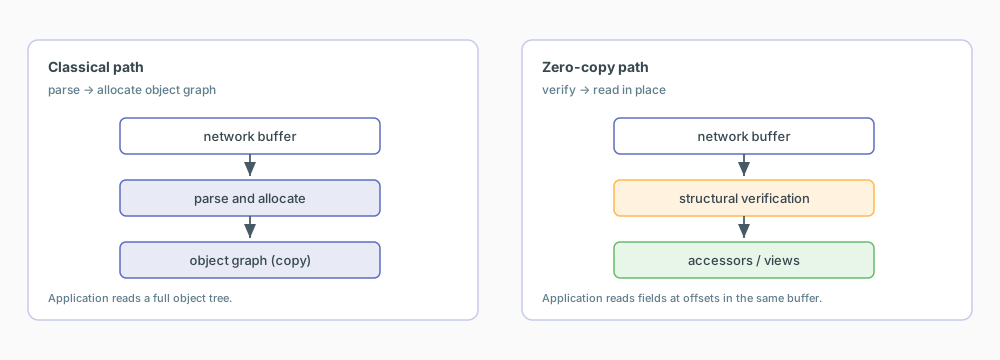
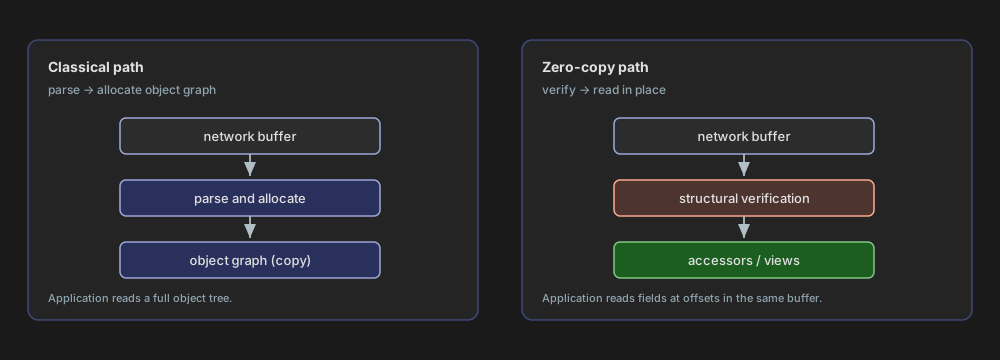
Information versus building full objects in memory. Interpreting bytes as typed fields is deserialization in the information-theoretic sense. What zero-copy designs avoid is the classical step of allocating a full data-transfer object graph that mirrors the message.
How it works
Layout contract (building on memory layout)
Recall from memory layout that a process-local structure may contain padding and host pointers. A zero-copy message format instead defines a portable layout:
- multi-byte integers appear at agreed alignments and byte orders;
- variable-length data (strings, vectors) are reached through offsets stored in the buffer;
- optional fields may be indicated by a table of field offsets. That table is often called a vtable in FlatBuffers documentation. A vtable is a small table of offsets that tells the reader where each field lives.
Beginner sketch — reading one integer field.
Suppose a verified buffer begins with a root table. Generated code might perform steps equivalent to:
  1. Let base = address of the buffer in this process.
  2. Read a root offset (e.g. 32-bit little-endian) at a known position.
  3. From the table at base+root, read the offset of field "price_cents".
  4. Load a 32-bit little-endian integer at that location.
  5. Return that integer to the application — without constructing a "Message" object
     that owns a separate "price_cents" heap field.
No host pointer from the writer’s address space appears in the file. Offsets are relative to the buffer. The image remains meaningful after the bytes are copied to another machine, given matching endianness rules as defined by the format.
FlatBuffers as a concrete case study
| Stage | What happens |
|---|---|
| Design | An IDL (interface description language) / schema declares tables and fields; tools generate readers and builders. |
| Encode | A builder API appends data (often depth-first) and patches offsets so the final buffer is self-consistent. |
| Verify | A verifier checks that offsets and lengths lie within the buffer (essential for untrusted input). |
| Read | Accessors traverse offsets; unread fields need not become heap objects. |
So “FlatBuffers does not deserialize” means “does not classically build the whole message as language objects in memory.” It does not mean “does no work and needs no schema.”
The encode path is not free
Builders must produce a correct buffer. Packing, offsets, and padding all require work. Workloads that mutate messages continuously may find the classical pattern simpler: populate a structure, then serialize. Zero-copy layouts are most advantageous when messages are constructed once and read many times, or when only a few fields of a large message are examined.
Validation
Avoiding the creation of full language objects in memory must not mean avoiding bounds and structural checks on untrusted data. FlatBuffers-style stacks provide verifiers. Using them on adversarial input is part of the security discussion in the engineering perspective. An unverified buffer is a collection of offsets that an attacker may craft to induce out-of-bounds access.
Mutation and operability
In-place updates are constrained. Sufficient space must already exist. Changing lengths is difficult. Many deployments treat buffers as immutable messages and rebuild when state changes. Debugging requires format-aware tools. Hexadecimal dumps are less informative than structured text logs.
Related but distinct ideas
Several ideas sound similar to message zero-copy but solve different problems:
| Idea | Relation to message zero-copy |
|---|---|
| Memory-mapped columnar formats (Arrow, Parquet access paths) | Zero-copy columns for analytical workloads—a different problem domain (data science perspective) |
span / buffer views on ordinary codecs |
Reduce copies without adopting a full zero-copy message format |
| Protocol Buffers with arenas or pooling | Fast creation of full language objects in memory, or reduced allocation. This is not the same layout model. |
| Values packed into shared bytes | Several values share one byte. Reading one of them means extracting bits. That is different from loading an aligned field directly from the buffer (Bit width is not bus width). |
Costs and constraints
| Axis | Typical effect of zero-copy layouts | Remaining responsibilities |
|---|---|---|
| Processor time (read) | Often lower for sparse access to large messages | Verification cost; access patterns |
| Processor time (write) | Builder complexity; not always faster than packed classical encode | — |
| Memory / allocations | Fewer objects on the read path | Buffer lifetime must outlive views |
| Size / bandwidth | Competitive; alignment may introduce padding | Not a substitute for compression (Compression vs format) |
| Evolution | Schema or IDL still required | Compatibility discipline remains |
| Security | Omitting verification can look “fast” and is unsafe | Always verify untrusted buffers |
| Operability | Specialized inspectors | Weaker ad hoc log readability |
Illustrative scenario
A mobile client downloads a large catalogue message. The user interface needs only a few fields per screen. Classical decoding may allocate thousands of objects at load time. A FlatBuffers-style buffer is retained (or memory-mapped) once, verified once, and read on demand. The same pattern appears in some remote-procedure-call or inter-process paths for large, immutable configuration snapshots.
The approach fits poorly for small, frequently mutated documents when builder complexity exceeds any gain. It also fits poorly when a team will not adopt schema tooling.
In this suite
Where FlatBuffers or a similar row zero-copy codec is registered for a language, compare it with other libraries on the same language, standard, data set, and data type. rkyv’s timed decode materializes an owned value, so do not read that row as an in-place access time. See rkyv versus Speedy. Absence from a language benchmark runner means the suite did not measure that library here. Categories and overviews record what is wired today: Serialization categories.
Common errors of reasoning
- Interpreting “no deserialization” as “no processor work and no schema.”
- Using zero-copy buffers received from a network without verification.
- Retaining views into a buffer that has been freed, recycled, or overwritten.
- Selecting zero-copy for small, highly mutable messages because a benchmark used large static ones.
- Comparing an unverified zero-copy path with a fully validating classical parser on speed alone.
Key takeaways
- Zero-copy means in-place field access from a designed layout. It does not mean “no interpretation of bytes.”
- “Does not deserialize” targets the classical step of building a full object graph as language objects in memory.
- Construction and verification still cost time. Security requires verification for untrusted data.
- Best fit: large or sparsely read, mostly immutable messages, with acceptance of schema tooling.
- Poor fit: tiny mutable documents, or environments that require text inspectability above all else.
- Columnar and buffer-view techniques are related but not identical.
- Interpret suite measurements in light of validation settings and access patterns.