Compare 200+ serialization libraries across 13 languages with fair within-language rankings—not marketing microbenchmarks.
Open live Dashboard Start Serialization 101 How we measure
What this project is
This suite runs the same data shapes through serializers in many programming languages, writes a shared CSV contract, and analyzes results with one statistics pipeline. Use it to compare libraries inside one language (and ideally one format family), not to crown a single global winner.
| You want… | Go here |
|---|---|
| Interactive charts, Pareto trade-offs, compare lab | Dashboard |
| One-question tests (why we do not only use the big table) | Experiments |
| Does this library match the RFC / spec section? | Dashboard · Compliance (#compliance/{lang}/{serializer}) · catalog notes |
| Course on formats and trade-offs (101–401) | Learn |
| Per-language runtime primer, library lists, and caveats | Languages (sidebar: C, C#, C++, …) |
| Methodology, metrics, how to add a codec | Benchmarks |
Same data · same pipeline
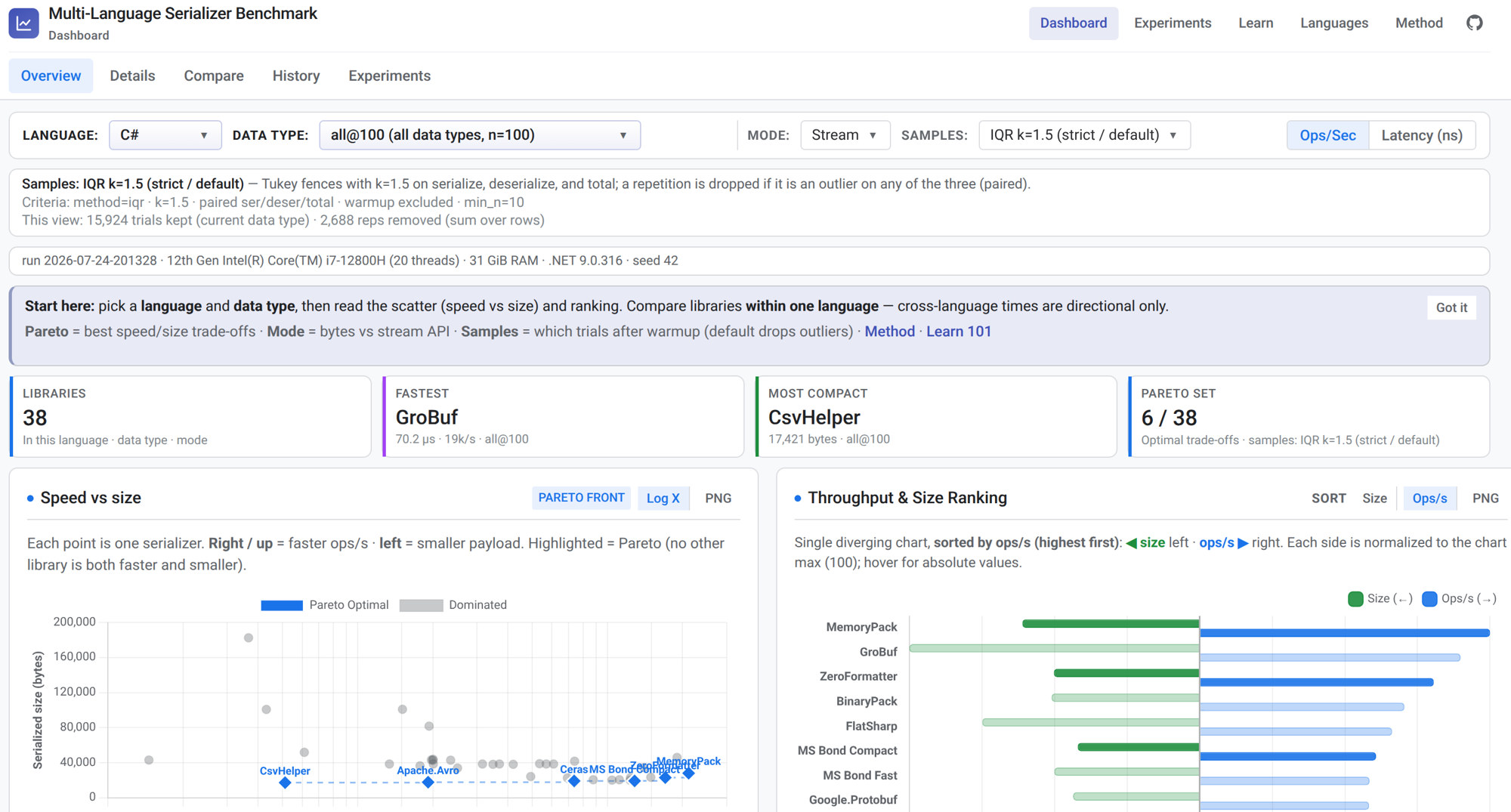
The live Dashboard is the published home for measured numbers. Pick a language and a data type, then read speed vs size and the ranking. Language indexes list the roster and caveats.
Languages
Thirteen runners share the same fixtures and analysis rules.
| Language | Serializers |
|---|---|
| C · Dashboard | 20 |
| C# · Dashboard | 38 |
| C++ · Dashboard | 27+ |
| Go · Dashboard | 19 |
| Java · Dashboard | 18 |
| JavaScript · Dashboard | 20 |
| Kotlin · Dashboard | 26 |
| Mojo · Dashboard | 6 |
| PHP · Dashboard | 15 |
| Python · Dashboard | 16 |
| Rust · Dashboard | 16 |
| Swift · Dashboard | 14 |
| Zig · Dashboard | 17 |
Learn the ideas first (optional path)
If you are new to serialization, start with the course under Learn:
- Serialization 101 — what serialization is; three lenses
- Serialization 201 — how formats work under the hood
- Serialization 301 — production judgment
- Serialization 401 — wire formats and labs
Then return to the Dashboard with clearer questions.
Honesty rules (short)
- Prefer comparisons within one language and one paradigm family.
- Implementation quality often matters more than the format brand name.
- Payload shape changes costs a great deal.
- Numbers on this site are from this suite’s runners and analysis—not a universal ranking of all software.
Full methodology: Benchmarks overview · Analysis methodology · Claims and replication.